renaissance…?
I’d almost forgotten I had this blog. I’m surprised it’s still here. It may well be worth reviving. I can see I had a few drafts saved that are now pretty much…. duds. I may need to do a little tidying up. Let’s see if this still works…
It lacks only a little
Posted by wangbo in NZ and China, tilting at windmills on January 6, 2015
For all the talk of cultural differences, it’s amazing the similarities that can be seen if only you look. One could be forgiven for thinking New Zealand’s national motto is “she’ll be right”. China has a similar saying – “差不多/chàbuduō”.
It is always dangerous to break down a Chinese word into a character-for-English-word translation, but done carefully in the right circumstances it can help us understand a word. 差不多/chàbuduō I would break down as “lacks (差/chà) not (不/bu) much (多/duō)”, giving you the range of meanings in that MDBG entry linked to above. It starts out as “almost” or “nearly” as in “we’re only a couple of kilometres short of our destination” or “we’ve done nearly enough to graduate”, but then gets dragged out to mean “good enough”, “it’ll do”. Still, embedded in the word is the idea that no, actually, it’s not quite enough.
Many years ago I used a Chinese reading textbook I have long since misplaced that had as the main text for one lesson the story of 差不多先生/Chàbuduō Xiānsheng/Mr Closeenough. In this story, the title character bumbled through life blithely settling for second-rate work with a breezy “chàbuduō”. Then one day he was due to catch an intercity train for a business trip. He arrived at the station just in time to watch his train depart without him, and greeted this sight with glum, incomprehending surprise: “The train was scheduled to leave at 11am, I arrived at 11:02, isn’t that close enough?”
This has always reminded me a lot of New Zealand’s traditional “she’ll be right” attitude.
“So you’re going to transport that hungry lion in a rusted-out cage held together with No. 8 wire on the back of a truck with bald tyres and dodgy brakes through a heavily-populated area at rush hour? Do you really think that’s a good idea?”
“No worries, mate. She’ll be right.”
What could possibly go wrong? Or perhaps a little more realistically:
“Shouldn’t you be wearing life jackets when you go fishing in that aluminuim dinghy? And did you check the forecast? It looks like the weather’s going to change.”
“Nah, she’ll be right.”
The consequences of ‘she’ll be right’ can be just as disastrous as those of ‘chàbuduō’.
The trouble is, though, that neither ‘she’ll be right’ nor ‘chàbuduō’ are wrong. Or should I say, in the right time and the right place, applied with reason, these attitudes can be the healthiest to adapt. Perfection is not possible. Compromises have to be made, and sometimes that means trading off one value for another. Imagine if in 1978 Deng Xiaoping had said, “Yes, China wants foreign investment, but only the best, highest tech, most advanced kind.”
And besides, life tends to be a rather risky business. Imagine if Richard Pearse had sat pondering his plans for powered flight and thought, “Nah, seems a bit dangerous.” Or if Bill Hamilton had said, “Nah, that river really is a bit too shallow, and golly, we don’t want to go too fast, now, do we?”
You’re never going to get perfect. Unless you’re mega-rich you’re probably never going to get the best. Whatever you do is going to involve a certain amount of risk. You’re just going to have to settle for the best you can get in the circumstances you find yourself in.
But it’s a time and place thing. Given the sensitivity of food safety in China, especially the safety of products aimed at Chinese children, I firmly believe that New Zealand’s exporters of agricultural and horticultural products can not afford even one millisecond of “she’ll be right”, nor can they allow their Chinese business partners even a glimmer of “chàbuduō”. As for the field I’ve been working in, another of New Zealand’s big export earners, education, the complex mix of ‘chàbuduō’ and other potentially dangerous attitudes perhaps deserves its own post. Suffice to say, for the time being, that this is a problem New Zealand’s educators also need to be well aware of, and wary of.
But for now, my question is, whether it’s “she’ll be right” or “chàbuduō”, are you using that as an excuse to settle for second (or third or fourth) best? Or are you saying that this is the best that can be achieved under the current circumstances?
Education, training, …. opportunity?
Posted by wangbo in NZ and China, tilting at windmills on December 21, 2014
Yesterday morning I read this article by Gordon Orr at McKinsey on what could happen in China in the coming year to two groups whose members I thought would find it interesting. It covers a pretty wide range of economic issues, and it most certainly does not proclaim the use of gold paving stones on China’s roads, but the very small section that really grabbed my interest was the two paragraphs headed “Students reinvent themselves for the jobs of 2015”. It paints a depressing picture for China’s university students, but the prospects for those soon to graduate have not looked particulary good for some years now.
There are two particular points in these two paragraphs that I want to look at. I’ll title one “The System” and the other “Changes”. I also see an opportunity here.
The System:
Let’s look at the third sentence of the first paragraph:
Indeed, many will find what they learned and how they learned at university has done little to prepare them for the 2015 job market in China.
Now, part of me wants to fly off on some wild rant about how the fundamental assumptions underlying that statement are all wrong…. but that’s a topic for another day. Grumble and grouch as I might, the world expects university graduates to be ready for work, and for universities to prepare students for work. And I see two key components to that sentence:
- …what they learned…
- …how they learned…
I don’t think there’s much reasonable, rational or helpful that can be said about the “what they learned” component, as that’s going to vary so wildly across academic disciplines, and for vastly different reasons. But it is fair to say that universities could ask themselves some hard questions about why they are requiring students to take many of the classes they grudgingly sit through. One problem is the sheer rigidity of the system. It is not uncommon to hear students complain that they have no interest in what they are studying and that they’d much rather be studying something else. There are a variety of reasons for this – their grades on the College Entrance Exam/Gao Kao and parental demands are two of the more common – and, of course, what they would prefer to be studying can change through the course of their undergraduate career as they learn more about the world and themselves. But they find themselves in a very rigid system in which they have very little control over what they study and they find it very difficult to change majors or otherwise pursue their real interests.
“How they learned”, well, there is a point that really needs some good, hard thinking and far-reaching reform. What follows is gross generalisation to be taken with an appropriately-sized grain of salt: Chinese education is still very teacher-centred, still very much about a teacher standing at the front of the room presenting information for students to memorise and regurgitate in an exam.
A common complaint I hear, something I seem to see evidence of as I walk past classrooms, something I have experienced on a course I took nearly two years ago, is “PPT-itis” – the over-reliance on powerpoint presentations, even to the extent of substituting actual planning and preparation for a powerpoint, perhaps even one borrowed from somebody else, and then simply reading that out. In one extreme case, students told me of one teacher sight-translating English-language presentations she hadn’t even looked over before class and having to stop mid-lesson and run words she didn’t know through Baidu Translate. But hey, the information is being presented to the students, isn’t it? So isn’t the job being done?
But there’s a third point missing from Orr’s analysis: Credentialism. Very many students are worried less about learning anything and far more about getting their degree, or passing the CET Band 4 and 6 exams being held this weekend, or the many other exams out there, because they know that when they are out looking for work, many potential employers are going to be more interested in seeing their credentials, the piles of magic pieces of paper officially proclaiming they have passed this or graduated from that, than their actual abilities.
Remember, those are gross generalisations about a large, diverse country. Of course, I can think of plenty of counter-examples. But they hold as true as generalisations can – those are common problems in Chinese education.
So back to Orr’s point – an awful lot of graduates are woefully underprepared for actual work. But how could they be prepared by a system so teacher-centred and so focussed on the accumulation of credentials?
Changes:
Here are the final two sentences of the second paragraph:
Growth in vocational schools is being boosted by many newly graduated students who realize they need to gain more work-relevant skills. Those students still in school will become more vocal in demanding change in what and how they are taught.
It’s a pity that Orr does not seem to distinguish between universities, which were not founded to train people for jobs and should not be required, or even requested to, and vocational schools, but again, that’s a rant for another day. Here he offers a solution: Vocational schools.
But are student demands really going to drive the change? My impression is that students enter university all bright-eyed and bushy-tailed looking forward to all the freedom they’re about to get to experiment and explore and generally just do what they’ve been wanting to do for years, but well before they graduate they’re hardened and cynical and just playing the game because these are the rules and this is the system they’ve found themselves in. Are employer demands going to drive the change? Complaints about graduates being incapable of actually doing anything have been around for years, and yet nothing seems to have changed.
An opportunity?
New Zealand universities, polytechs, and schools generally have been recruiting students from China for many years now, yet for all the importance of export education to the New Zealand economy, and despite China’s position as the number one source of international students to New Zealand schools, I think that in this mess of issues with Chinese education there are still some important points for New Zealand schools to remember.
New Zealand’s universities generally offer a much more flexible, student-centred education, and this needs to be emphasised. Students have much more freedom in New Zealand to explore a wider range of subjects and disciplines, much more freedom to change their majors, and much more freedom to mix and match subjects into double majors and double degrees.
New Zealand’s polytechs/institutes of technology focus on vocational training, actually preparing students for work, developing a set of skills that will set them on a path to a solid career. This, too, needs to be emphasised.
And the quality of this education and training needs to be emphasised, too. No amount of beautiful, clean, green scenery is going to cut it. Chinese parents are not parting with huge sums of money so their kids can enjoy a stereotypical New Zealand lifestyle. They’re investing in their kids’ future, and they want to be sure that investment is going to bring good returns.
But there is a challenge: New Zealand, even though its most populous island is the biggest fish ever caught by any fisherman, is a very small fish in a very large pond stocked with many very large fish. New Zealand is easily lost and overlooked in this crowded, noisy environment. Over the years many students have asked me about studying in New Zealand and almost all of them have been coming from a position in which all they know about New Zealand is that it’s the very beautiful homeland of their teacher. On one quite memorable occasion a student who was about to graduate and head off to a much larger, better known country to do her masters told me that when she started university she thought of New Zealand as a place to go when you’re old, and not as a country for young people, and she now kind of regretted that, having since learned a little bit more about the world.
My problem now is that I can’t tell you how New Zealand can do any better at getting its message out there. I can tell you that an awful lot of people are marketing New Zealand education. Many schools have official Weibo accounts. I know people in the industry. For years New Zealand schools have been doing deals with Chinese schools. I have a Baidu news alert for 新西兰 (Xīnxīlán, New Zealand) emailed to me each morning and a huge proportion of its contents are some variation or another on “study in New Zealand”.
But I can also tell you that this widespread dissatisfaction with China’s education system still represents a huge opportunity for New Zealand.
so that’s that then
Posted by wangbo in life in Beijing on December 19, 2014
I’m done. Finished. Well, not quite, but….
Yesterday morning was my last ever lesson taught at this university. Or in China. I had lessons scheduled for yesterday afternoon and this morning, but those times were given over to final speaking tests. Now I have two writing tests on Monday and a pile of papers and recordings to grade and paperwork to be done and submitted.
Then two New Years’ celebrations (one of the advantages of running two calendars at once… ), two months and five days and we’re on a plane out of here, making our way down to New Zealand to start a new life.
Fifteen years of teaching English in China has come to an end. I’ve seen, heard, felt, experienced a lot. Maybe even learned a thing or two. Now I need to put fingers to keyboard, pixels to screen…
Substandard NuZealand?
Posted by wangbo in news, NZ and China on December 1, 2014
This morning I saw this article in Yangzhou News, attributed (but not linked) to Beijing Business Today, reporting that 纽睿智 infant formula from New Zealand was on AQSIQ’s October list of substandard imported food and cosmetic products. Unfortunately there’s precious little information beyond that in the article, and searches of AQSIQ’s website aren’t turning up any more. But a little time on Google turns up this – 纽睿智’s website, with the English name ‘NuZealand’, and this, a tiny stub of an article that confirms NuZealand infant formula was on the October list of substandard products and gives two more details – it was 8197kg of product that failed inspection and was recalled, and it was made by New Zealand Dairy Products Limited, whose website seems to confirm, with a faintly-coloured link at the bottom of the front page, it produces NuZealand milk products. Also, on their products page, clicking on pictures of the NuZealand-branded products takes you either to the 纽睿智 page linked above, or to this page.
Now I do not know how much truth there is to these reports, and the lack of confirmation on AQSIQ’s own website doesn’t help. But that tiny stub of an article on foodqs.cn linked above ends with this paragraph:
新 西兰奶粉一直是国内妈妈追求的好品质奶粉,不过,由于中国需求量大,很多不良企业开始大量进口一些品质不好的奶粉进入中国市场,希望谋求高额利润。虽然 新西兰有着优质的奶粉品牌,不过,不一定新西兰奶粉就是好奶粉,希望广大消费者能够通过正规渠道,选购知名度较高的奶粉品牌,防止一些品质差的小品牌混入 中国市场。
New Zealand milk powder is good quality milk powder that has been consistently sought after by Chinese mothers, but, because Chinese demand is large, many bad companies have begun bringing some poor quality milk powder into the Chinese market, in search of large profits. Although New Zealand has good quality brands of milk powder, New Zealand milk powder is not necessarily all good. We hope that consumers can go through proper channels to buy better-known brands of milk powder to prevent poor quality brands from mixing into the Chinese market.
Now there is a very important warning that all New Zealand businesses exporting, or wanting to export to China really need to take on board. It’s a warning that’s been out there for a few years now. If you’re exporting to China, especially if you’re exporting food and/or products aimed at Chinese children, you’d better make sure your quality and safety standards are beyond perfect. China’s tolerance for substandard imports came to an end some time ago.
Cross-posted to my LinkedIn.
three manys?
Posted by wangbo in news, NZ and China on November 20, 2014
With Xi Jinping visiting New Zealand there is naturally an upspike in mentions of New Zealand in the Chinese press. Naturally, these mentions tend to be about Xi’s visit, but there are other things too. Things like this rather odd little article, attributed to Zhou Qiyuan of Nanjing Daily. “New Zealand has ‘three manys'”, the headline proclaims, “Many sheep, many birds, and many old people”. It then goes on to explain each of those ‘many’s one by one. It’s a pretty short article, so I’ll just translate the whole thing.
It starts with the ‘many sheep’:
新西兰是现代化农牧业国家,一年四季都有绿草地,牧场管理先进,只见牛羊,不见人。全国人口四五百万,羊儿却有两千多万,羊毛、羊皮、羊肉制品出口占国家经济重要地位,被称为“骑在羊背上的国家”。
New Zealand is a modernised agricultural country. The grasslands through all four seasons. Farm management is advanced, and only cattle and sheep can be seen, but no people. The whole country has a population of four or five million, but there are 20 million sheep. Exports of wool, sheep skin and sheep meat products occupy an important place in the economy. It has been called “a country riding on the sheep’s back”.
媒体上有关羊的趣闻也多,前不久有一只羊逃避剃毛,躲进山洞,在野外生存了2年多才被牧主发现,念其追求自由的顽强精神,牧主宣布对其大赦:永不剃其羊毛。
There’s lots of interesting news about sheep in the media. Not long ago a sheep escaped from shearing and hid in a mountain cave, living in the wild 2 years before it was found by the farmer. In honour of its tenacious spirit searching for freedom, the farmer announced an amnesty for it: its wool would never be shorn again.
新西兰鸟多,而且鸟儿喜欢飞出树林,与人类相处,因为人们喜欢与它们分享美味,又不捕捉它们。首都惠灵顿市中心有野鸽、海鸥、麻雀等觅食,人们坐在公园长椅上,一边休息一边掰面包、饼干喂食鸟儿,那场景很是悠闲融洽。
New Zealand has many birds, and the birds like to fly out of the forest. They get along well with people because people like to share delicacies with them, rather than catch them. Wild pigeons, seagulls, sparrows, and other birds search for food in the centre of the capital Wellington. People sit on park benches resting and breaking bread and biscuits to feed the birds, a sight full of leisure and harmony.
在新西兰,到处能看到老人开车。别担心,他们从年轻时就开始开车,早已轻车熟路。新西兰有一句歇后语就是:“老爷爷开车—四平八稳。”新西兰航班上竟然有 “空中老太”,她们都是以前的空姐、空嫂。新西兰的退休制度比较灵活,有按时与超时两种选择,到退休年龄,如果你愿意延期,而且体检合格,就可以继续工 作,所以这里的各行各业老人有很多。
Everywhere in New Zealand you can see old people driving cars. But don’t worry, they’ve been driving since they were young, and are long comfortable with the car and familiar with the road. New Zealand has a saying: “An old man driving a car – stable and steady”. On New Zealand flights there are “air old ladies” – former air hostesses. New Zealand’s retirement system is relatively flexible, and one can choose between ‘on time’ or ‘over time’. On reaching retirement age, if you want to keep working and you are fit, you can continue to work, so in every industry you can see many old people.
And that’s it.
What a strange, strange article. Granted, it’s been a long time since I’ve lived in New Zealand, so things have certainly changed, but as I’ve been preparing to return to New Zealand I’ve been paying a lot more attention to the NZ media and internet, and nothing I have read, seen or heard suggests NZ has changed quite that much. Let’s look at it ‘many’ by ‘many’:
- Many sheep. Yawn. The same old stereotype. At least they managed to update the numbers – when I was a kid it was “3 million people and 60 million sheep”, but economics has intervened since then – there’s much more money to be made in milk than wool, apparently. Still, ‘four or five million’ suggests Zhou hasn’t been overly diligent about getting accurate figures, and last I heard the saying was “built on the sheep’s back”, and applied equally to both NZ and Australia. Don’t forget, Australia’s most populous region is the southeast, the area inside the dog fence, which is traditionally sheep-farming country – for more, see “Waltzing Matilda”, and translate the lyrics into something approaching standard English.
- Many birds. On seeing that, I would’ve expected something about NZ’s native avifauna, which is pretty special in many ways. Remote islands do tend to have quite unique ecosystems. But no, pigeons, seagulls and sparrows. Of downtown Wellington. I grew up in Wellington, and I honestly can’t remember anybody expressing any fondness for those birds. Sure, people feed them. Sure, nobody tries to catch them – but why on Earth would you want to? I remember those birds as being seen more as flying rats and a nuisance than anything else. But then again, my wife has somehow got the impression that us Kiwis like our birds. That may say more about me than my compatriots, but she got that impression somehow. Oh, wait, we call ourselves Kiwis…. hmmm…. We have some pretty special native birds, like kiwi, kokako, kea, kereru, fantail, morepork, kaka, tui, pukeko, takahe, weka, whio, and so on, and so on…. But no, it’s people feeding flying rats in central Wellington that left a lasting impression on this reporter.
- Many old people. Oh dear. Every country has old people. China is also an ageing country with a lot of old people. I guess one obvious difference here is that widespread car ownership happened much, much earlier in NZ than in China, so the sight of old people who have been driving longer than most Chinese people have been alive is not so strange for a Kiwi, but perhaps a bit of a shock for this particular reporter. But that “New Zealand saying”? I’m going to go out on a limb here and accuse Zhou of interviewing her keyboard. After all, the second half, “四平八稳”, is a Chinese saying. But, sure, I can’t say I’ve heard of anybody being forced into retirement in NZ, although I have heard of that happening here in China.
So, altogether rather strange. Perhaps Nanjing Daily should consider sending a better reporter next time – one with a bit more life experience and keener observation skills, perhaps?
how long until we learn?
Posted by wangbo in Chinese study, tilting at windmills on October 17, 2014
This morning I sat in the classroom reading as I waited for students to arrive for their spoken tests. Among other things, I read chapters 3o and 31 of the Dao De Jing:
30: 以道佐人主者,不以兵強天下。其事好還。師之所處,荊棘生焉。大軍之後,必有凶年。善有果而已,不敢以取強。果而勿矜,果而勿伐,果而勿驕。果而不得已,果而勿強。物壯則老,是謂不道,不道早已。
He who would assist a lord of men in harmony with the Dao will not assert his mastery in the kingdom by force of arms. Such a course is sure to meet with its proper return.
Wherever a host is stationed, briars and thorns spring up. In the sequence of great armies there are sure to be bad years.
A skilful (commander) strikes a decisive blow, and stops. He does not dare (by continuing his operations) to assert and complete his mastery. He will strike the blow, but will be on his guard against being vain or boastful or arrogant in consequence of it. He strikes it as a matter of necessity; he strikes it, but not from a wish for mastery.
When things have attained their strong maturity they become old. This may be said to be not in accordance with the Dao: and what is not in accordance with it soon comes to an end.31: 夫佳兵者,不祥之器,物或惡之,故有道者不處。君子居則貴左,用兵則貴右。兵者不祥之器,非君子之器,不得已而用之,恬淡為上。勝而不美,而美之者,是樂 殺人。夫樂殺人者,則不可以得志於天下矣。吉事尚左,凶事尚右。偏將軍居左,上將軍居右,言以喪禮處之。殺人之衆,以哀悲泣之,戰勝以喪禮處之。
Now arms, however beautiful, are instruments of evil omen, hateful, it may be said, to all creatures. Therefore they who have the Dao do not like to employ them.
The superior man ordinarily considers the left hand the most honourable place, but in time of war the right hand. Those sharp weapons are instruments of evil omen, and not the instruments of the superior man; – he uses them only on the compulsion of necessity. Calm and repose are what he prizes; victory (by force of arms) is to him undesirable. To consider this desirable would be to delight in the slaughter of men; and he who delights in the slaughter of men cannot get his will in the kingdom.
On occasions of festivity to be on the left hand is the prized position; on occasions of mourning, the right hand. The second in command of the army has his place on the left; the general commanding in chief has his on the right; – his place, that is, is assigned to him as in the rites of mourning. He who has killed multitudes of men should weep for them with the bitterest grief; and the victor in battle has his place (rightly) according to those rites.
And it occurred to me that in similarly ancient times at the opposite end of Eurasia from where Laozi sat somebody said:
Put your sword back into its place; for all who take the sword will perish by the sword.
— Matthew 26:52
And yes, Laozi was writing circumstances very different to those in which Jesus was speaking, but the two sentiments are similar and not unrelated.
And it occurred to me that if people living 2000 and more years ago in places as diverse as Roman-occupied Palestine and Warring States China could come to such similar conclusions as to the value of weapons and violence, then surely, just like the Golden Rule, it must be a principle and a value so universal it can be found in one formulation or another in many different cultures, many different philosophical and religious traditions, many different times from ancient to modern, many different places.
Apparently people have done studies counting up deaths and their causes through history and have concluded that as time has marched on, people’s chances of dying early from violent causes have gradually trended downwards. Our species has been getting less violent, not that you’d know it from watching the news (so don’t watch the news). There is evidence that we are in fact slowly evolving from barbarity into something approaching civilisation. But for all the painfully slow cultural evolution over the four or five thousand years for which we have some form or another of written records (of varying and frequently dubious quality), some things about our species remain stubbornly the same. And so the writings and ramblings of ancient prophets, loudmouths, poets, madmen, sages, rabble rousers and philosophers remain as relevant now as when Socrates was handed his cup of hemlock.
And yet for all of our slow evolution into finding less drastic, more civilised methods of dispute resolution than grabbing the nearest weapon and lashing out and for all the people who have read the two books just quoted over the last couple of thousand years, our leaders still seem awfully eager to bellow their bellicose rhetoric, beat their drums, and march us off to War.
The Ancients warned us: War may sometimes be necessary, but it is never good, and really should be avoided if at all possible.
How long will it take until we learn?
Dakang, An Yuan, Crafar, Lochinver, Shanghai Pengxin…
Posted by wangbo in news, NZ and China on September 17, 2014
Today I see news that a company called Dakang Muye (大康牧业) is planning to spend 2.3 billion to buy two New Zealand farms. Exactly how big a sum 2.3 billion is depends, of course, on which currency we’re using. I think it safe to assume from context that the currency is Chinese Yuan/Renminbi. In which case, 2.3 billion would translate to NZ$ 457,613,434.77. Now, I have no idea how that link to XE.com will work, but that is the figure I was given. Also, I googled “大康牧业”, and among all the news articles was a site that looked like it might belong to the company, but AVG gave me a big, red, angry “Danger! Don’t go there!” warning, so I won’t link to it.
My knowledge of finance and stock markets is extremely limited, so I may well make some mistakes here. If so, please do enlighten me. But the first paragraph seems to be saying that Dakang plans to raise 2.314 billion yuan through a private placement of 239 million shares priced at 9.69 yuan each, with the balance after fees have been paid to be used to purchase and remodel the Crafar Farms and Lochinver Station.
But wait! Wasn’t it Shanghai Pengxin purchasing the Crafar Farms and Lochinver Station?!
Well.
Paragraph 2 says that the company (Dakang) will use the money raised to buy 100% of An Yuan Dairy, An Yuan Dairy’s indirectly held title to the Crafar Farms, and the agreement to buy Lochinver Station signed by its subsidiary Pure 100. This will allow Dakang to indirectly take ownership of the Crafar Farms and purchase Lochinver Station.
Paragraph 3 seems to be a clarifier, answering, “So who’s who and who owns who?” I’ll do my best to get this all straight. Paragraph 3 identifies An Yuan as the Hong Kong-listed wholly-owned subsidiary of Dakang’s controlling shareholder Shanghai Pengxin. So, Shanghai Pengxin is selling 100% of its wholly-owned subsidiary An Yuan Dairy to Dakang, a company in which it has a controlling stake. Which begs the question: Who owns the rest of Dakang?
This paragraph also gives some basic information on the Crafar Farms and Lochinver Station. But the next paragraph is where it gets exciting, pointing out that the combined 22 thousand hectares of the Crafar Farms and Lochinver and the 4000 hectares managed on behalf of Synlait Farms would make Dakang the third largest holder and operator of farmland in New Zealand, with annual production of milk solids from these three farms [note: yes, Crafar is 16 farms, but the article treats them as one unit in this sentence] projected to reach 15 million kilograms.
And the goal, the next paragraph explains, is to create a unified production chain, allowing Dakang to supply all the infant formula and liquid milk for its subsidiary Shanghai NuZealand itself.
And yes, judging by this article from April last year, NuZealand is the ‘English name’ chosen for ‘纽仕兰 (Niǔshìlán)’.
And judging by this article from 21 July this year, Dakang bought a 0.64% share in NuZealand from its controlling shareholder Shanghai Pengxin for 8 million yuan.
And now I am running out of time, so I shall leave it at that for now.
going fruity
Posted by wangbo in Uncategorized on August 8, 2014
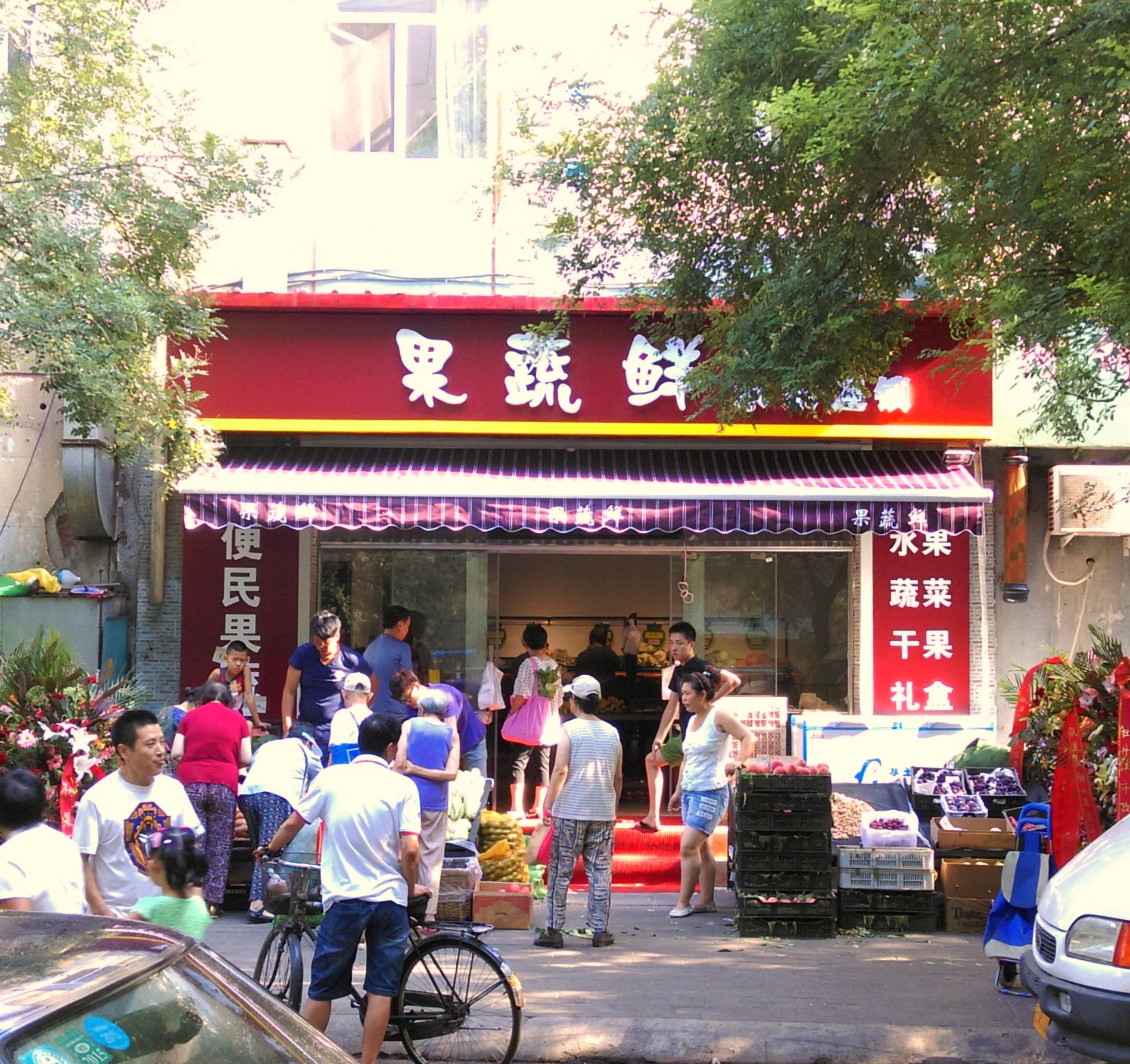
I’ve noticed more and more stores like this popping up around the neighbourhood recently. The earliest ones started to appear a few years ago, but there seems to be a sudden increase in them. Here’s a few points I’ve noticed about them:
1: The aesthetic seems to be largely the same among all such stores, from the general layout right down to the colour schemes, size, style, and fonts on the signage.
2: Although they are generally green grocers, the focus is definitely on fruit – to the point where the names of the stores, be they independent or branches of a chain, always feature the character 果 (guǒ, fruit). In this photo, the store’s name is 果蔬鲜 (Guǒ Shū Xiān), which, in addition to having quite a pleasant sound, means literally “Fruit Vegetable Fresh”. Another new grocer I’ve seen is called 多果多 (Duō Guǒ Duō) – “Lots of fruit, lots”.
3: This is perhaps the important bit: These stores seem to be occupying a previously vacant niche between supermarkets and markets. The example in the photo above is located in a residential area right around the corner from a lane that becomes an impromptu market in the mornings. Not far away is the large, 2-storey barn that the local outdoor market was moved in to a few years back. About 500 metres down the road is a supermarket. And so the locals have choices: They could buy their fruit and veges from people squatting behind blankets spread out on the ground; They could walk a little further and buy from a market which is certainly cleaner and has a full range of other daily goods and necessities, but is still very much small stallholders, with all the nagging little questions about where they’re really sourcing their products from; They could trek down to the supermarket and pay definitely higher prices while getting no greater a range of produce to choose from; Or now they can shop at this new green grocer, which has a good range of fruit and vegetables, and whose set-up and signage projects that same air of security and confidence as the supermarket.
Now, Zespri is doing a very good job. Zespri is easy enough to find, especially in higher end/international supermarkets. Zespri is doing well enough that I’ve seen cartons of kiwifruit in suspiciously Zespri-like colours with suspiciously close to IPR-infringing labels. But I don’t see a lot of other New Zealand fruit around. It seems to me that New Zealand has two huge advantages when selling fruit to China, namely its clean, green, quality reputation and the off season. These new stores seem to me a good sign of the demand among ordinary Chinese for better quality goods and a better quality experience. Surely New Zealand could step up?
China Connection
Posted by wangbo in NZ and China on July 18, 2014
Note: This is a very slightly altered version of a post I wrote on my Linked In profile. There’s a link to my Linked In profile on the right sidebar if you’re interested.
The New Zealand Herald has been running a China Connection series by Paul Lewis in association with the BNZ every Friday, and as the series continues it gets more interesting. Today’s instalment looks at SMEs and China, and there are three points that grabbed my attention.
The first point may well come across as a bit nit-picky on my part, but I will explain. Look at this sentence:
“Last month, BNZ took a delegation of exporters – dairy farmers, croppers and mixed agri-business interests – to Shanghai, Beijing and Xian, checking out export opportunities.”
There is a spelling mistake here, and it is not as minor as it seems. The problem is in the names of those three Chinese cities. Now, it is fair to not include tone diacriticals, as a strict adherence to the rules of Hànyǔ Pīnyīn would dictate, firstly because the article is in English and aimed at a general anglophone reader base, and secondly because very few Chinese people bother including tone diacriticals. Far more important, though, is the missing apostrophe. In Hànyǔ Pīnyīn, when the spelling of a word creates some confusion as to whether it is one syllable or two, or where the break between two syllables is not made clear by the spelling, an apostrophe is used to separate the two syllables. Xian is one single syllable, and therefore one Chinese character, perhaps 先 (first), 县 (county) or 线 (line). The name of the capital city of Shaanxi Province is Xi’an – the apostrophe makes clear that it is two syllables and where those two syllables break. In Chinese characters it is 西安 – you can see the difference between the city name and the monosyllabic possibilities above.
This is not just a writing teacher being unnecessarily or excessively fussy about spelling, nor is it a Sinicised version of the rage some feel at the sight of the infamous ‘greengrocer’s apostrophe’. Attention to detail is important. David Cunliffe’s electorate office recently had a bit of bother digging up some old documentation because somebody had filed it under ‘Lui’ instead of the correctly-spelled ‘Liu’. I am aware of a recent case where somebody’s inattention to detail has caused quite a lot of strife for some new graduates, to the point where one has lost a job because her paperwork did not arrive in time, and other people’s jobs or enrolment in masters degree courses could be affected. Inattention to apparently minor detail can have some surprisingly big real world consequences.
The second point that grabbed my interest was this:
“The interests of the two countries tended to be complementary – Australian business tended to focus on beef and grains and minerals while New Zealand’s primary interest was dairy.”
The first reason that grabbed my attention is the image of the two countries playing to their relative strengths. That is absolutely what needs to be done. Unfortunately, in my experience in education, it is something that all too often fails to happen. I have seen far too many rely on something vague like “the English language” or “quality education”, perhaps with “comparatively cheap” thrown in. This is the wrong approach because plenty of other bigger, better known countries have exactly the same thing to offer. New Zealand is a very small player in a very large world, and so New Zealand needs to be very specific and very loud about the precise advantages and strengths that New Zealand has to offer. This applies to the country as a whole and to every specific company, organisation and institution looking to break into the China market. The deal EIT is doing with Qilu University of Technology that I posted about on July 4 (I hope that link works – I’m still getting used to Linked In’s set-up) is a good example of how things should be done – EIT playing up the specific strengths it and its region have to offer to a university and a region that stand to benefit directly from those strengths.
The third point to grab my attention was this:
Asked whether the two countries had a different approach to doing business in China, Healy said: “I think New Zealanders have a natural advantage in working well with other cultures. You can see how that comes out of daily life here.
“New Zealanders perhaps come across as more culturally aware whereas Australians maybe tend to be more strongly perceived as Australians. It means New Zealanders do well overseas, when dealing with locals from different cultures.
My experience has been different. Yes, New Zealanders do generally get along. I think that’s the advantage of coming from a conformist, non-confrontational culture – from an early age you are taught to find ways to blend in and compromise. But, well, put it this way: Although Americans have the reputation for being bad, ungrateful and ungracious travellers, I have met Americans who speak standard Mandarin better than most Chinese. All the Americans I’ve met in China who do not speak Mandarin have been apologetic about that fact. I have heard two New Zealanders boast about having lived in China for years and not speaking a word of Mandarin beyond the bear necessities to travel between work, home and play and keep themselves fed and watered. I have seen New Zealand programmes in China fail in part because management was blissfully unaware of the linguistic, cultural and social aspects of what they were trying to do in China. Quite simply, New Zealand does not value foreign language or cross-cultural communication skills anywhere near enough, and too few New Zealanders appreciate the importance of the linguistic, social and cultural aspects of business.
This ties into a theme that runs through Lewis’ article: Preparation. To succeed in China you must be well prepared. I have seen some arrive in China apparently thinking that Jim Morrison’s advice to Wayne in Wayne’s World 2 is all they need: “If you book them, they will come”. No. In addition to all the usual legal, financial and commercial considerations, you need to remember that you’re dealing with a very different culture and a very different society, and that everything is going to be translated into a very different language. It sounds obvious, and it is obvious, but I’ve seen too many forget this. For example, your posters full of pictures of young people climbing mountains, surfing, skiing and kayaking might be great for recruiting New Zealand students who are looking as much at lifestyle considerations as they are at study opportunities, but they will have Chinese parents saying no and moving on – and yes, I have seen this. But wait, “New Zealand students”, “Chinese parents”? Well, yes. If it’s education you’re selling you need to understand that there is a very different set of equations governing who makes the decisions and how. So how do you attract Chinese students? What is written about China in English represents only one tiny part of the picture. To keep up with how things are changing in China and how those changes are going to affect your business, whether it’s milk powder or IT or education, you need to get a fuller grasp of the overall picture. During Fonterra’s recent DCD and botulism scandals the New Zealand media passed on Fonterra’s and the MPI’s assurances that everything was fine. The Chinese media reported something rather different. You need to be able to listen to Chinese people and read what they write.